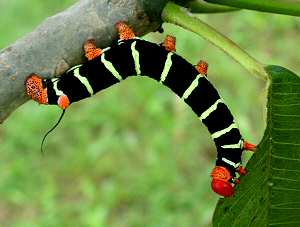
| Nearly every year, we see
the spectacle of the brightly colored caterpillars of
the Frangipani Hawkmoth (Pseudosphinx tetrio).
The bright red, black and yellow colors of this caterpillar
advertise the unpalatability of the caterpillars to
experienced predators. Indeed, prey that are not edible
to predators are predicted to gain by exhibiting conspicuous
and very recognizable colors; experienced predators
can then correctly identify and subsequently avoid attacking
such prey. The color pattern of this caterpillar are
classical colors used by aposematic insects. |
 |
 |
Such "aposematic" color patterns
are found everywhere throughout the world of insects,
from black and yellow-striped stinging wasps to black
and red, bitter-tasting ladybird beetles, or brightly-colored,
poisonous tropical butterflies (see also Janzen, 1980).
Being poisonous and aposematic does
not always help. Cuckoos are known for being able
to deal with hairy and/or poisonous caterpillars and
we have seen the Squirrel Cuckoo to the left coming
back to a caterpillar infested tree for yet another
snack!
Usually during November - December,
we find these caterpillars. They can be very common
and partly defoliate their hostplant. The hostplant
is the Frangipani or Plumeria rubra although
I have been shown pictures of this caterpillar feeding
on an Allamanda sp. Both belong to the Apocynaceae
family.
|
During the December month of 2003,
these caterpillars were so common at our place Green
Hills, that they completely defoliated
the shrubs they were feeding on and were even forced
to eat the main stem, since they depleted all available
leaves. Although the damage to the shrubs is severe,
we do expect the shrubs to recover.
The spectacle is always interesting to tourists and
other people interested in Natural History.
Many wonder what beautiful butterfly these caterpillars
will produce, but unfortunately, the result is a dull
gray moth (but a very large one) which is rarely seen
and flies most commonly during May-June and September-October. |
 |
 |
The hostplant Plumeria rubra acutifolia.
Frangipani or West Indian Jasmine, is native to Belize
and is a tree or shrub that in nature can reach about
40 feet (12 meters). It is found mostly on steep limestone
hills and other dry places.
The cultivated form of the Frangipana is Plumeria
rubra f. rubra and comes in a variety
of colors. The fragrant flowers are used as Leis in
Hawaii and other tropical islands.
Another Plumeria species in Belize is Plumeria
obtusifolia which is commonly found in dry forests
in the North of Belize |
Literature:
Janzen DH. 1980. Two potential coral snake mimics in a
tropical deciduous forest. Biotropica 12: 77-78.
Back to top
About Belize|Administrative|Publications|Species
Lists|Projects|Links|HOME
|